Mechanistic interpretability · Unified multimodal models

One Scene Code, Two Consumers

Causal Tests of Where Task Differences Live in a Unified Multimodal Model

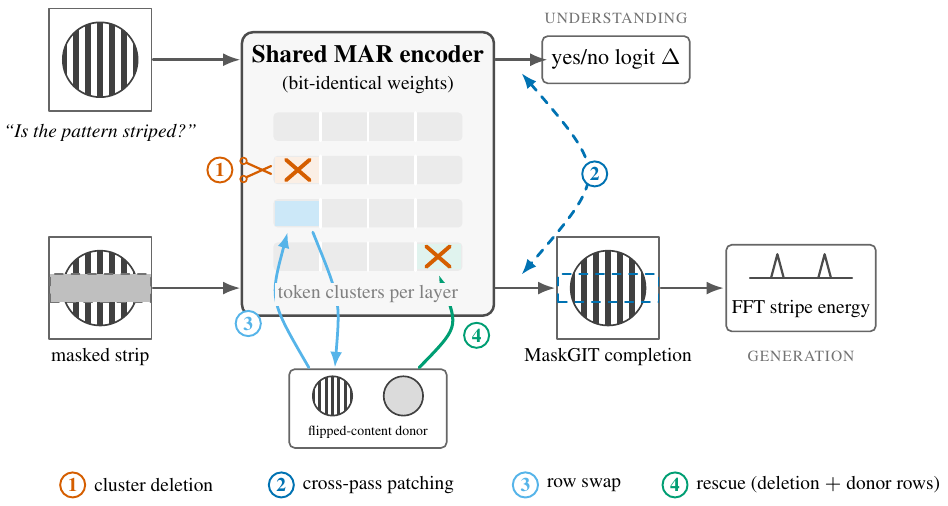
Teaser: one shared visual encoder feeds both an understanding pass and a generation pass; interventions on the shared scene code are read out through both.
One task-blind encoder writes a scene code that both tasks read. We intervene on that code and read the effect through both passes to ask where — and how — the two tasks actually diverge.

Abstract

Unified multimodal models such as Harmon route image understanding and image generation through one visual encoder with bit-identical weights. Because the encoder never sees the question or the generation regime, its task-blindness is a property of the architecture, not a discovery — so we use it as a controlled testbed for two questions weight sharing leaves open: is the shared representation causally interchangeable between tasks, and where do task differences actually come from? Three causal results give one answer: the encoder writes an editable scene code, and task differences emerge from how each downstream consumer recovers and uses that code.

The one-line story

A unified model doesn't split into a "seeing" network and a "drawing" network. Both read one shared scene code. What differs is the consumer — and where the architecture injects task context.

Three causal results

01

The shared code is causally interchangeable across tasks

Substituting the understanding pass's rows at a visual fact's token positions with rows from a content-flipped scene moves the answer 63–66% toward the donor at every encoder layer (random positions: 3–11%). Rows computed by the generation pass repair deleted understanding computation at 12 of 20 layers (71–99%), while wrong-content donors anti-rescue. One task can consume what the other computed.
02

Task differences are consumer × evidence, not path-intrinsic

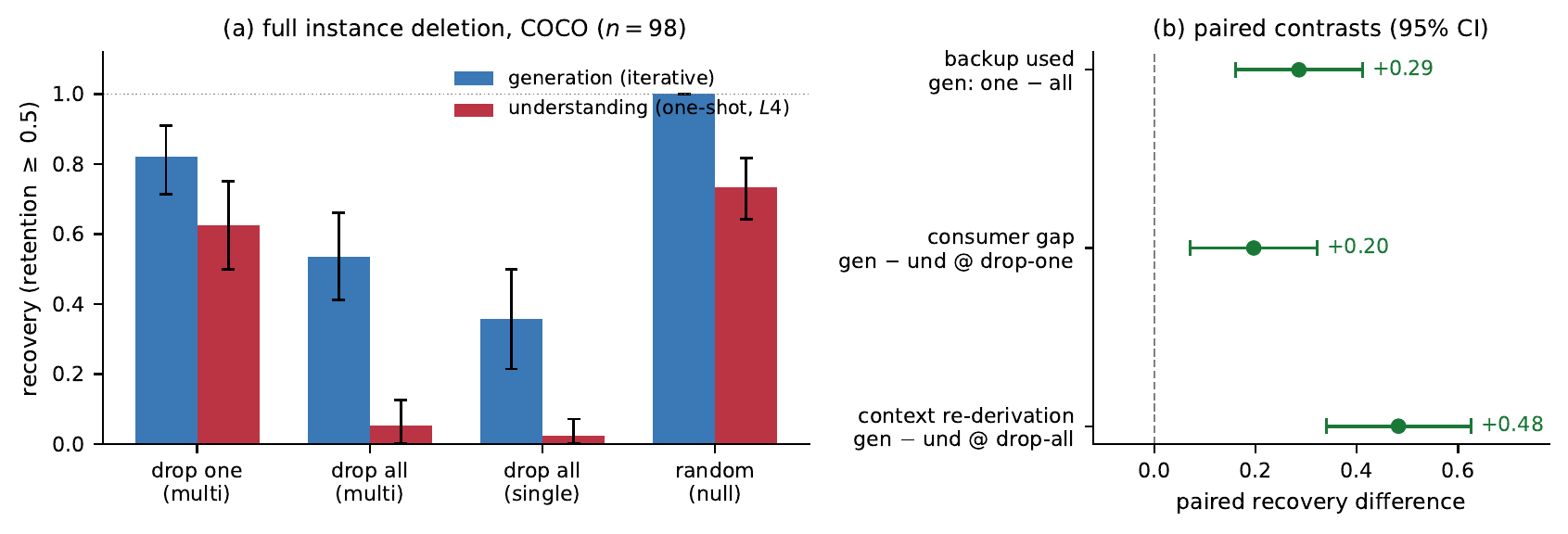
On 98 real COCO scenes, deleting one annotated object instance while others survive lets generation recover .82 of the answer signal, vs. .54 when every instance is deleted — the one-shot understanding reader collapses to .05 under full removal. With the object entirely gone and both consumers seeing the same input, generation still retains +.48 more at every layer: the iterative consumer re-derives missing evidence from spatial backups. Yet neither consumer survives corrupted evidence (0.74 → 0.07). Robustness is a property of consumer × evidence-redundancy.

03

Specialization begins as a rotation of a shared geometry

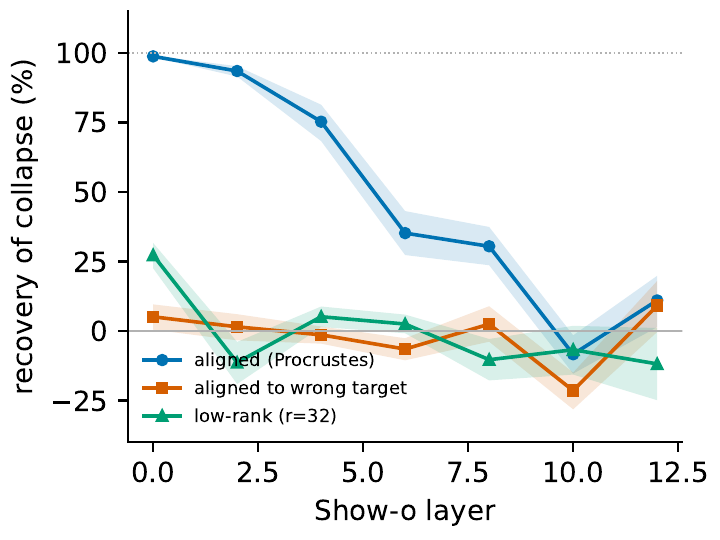
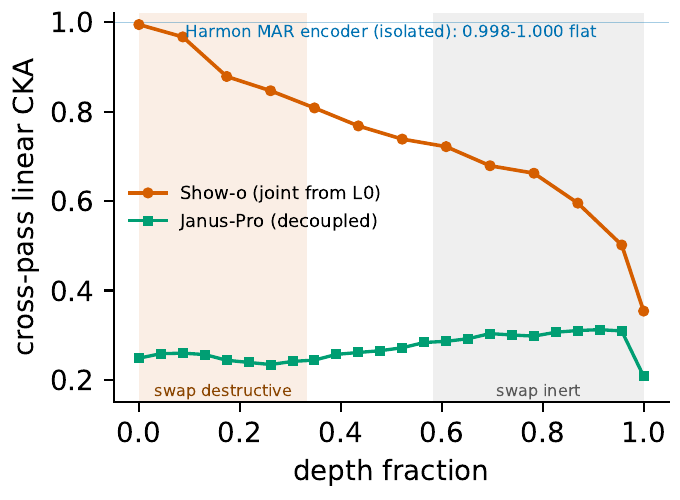
In the task-conditioned trunk, cross-pass similarity declines gradually (CKA 0.997 → 0.421). On Show-o, which mixes task context from layer 0, a causal cross-pass swap collapses at every layer even where CKA reads 0.995 — similarity is not interchangeability. The mechanism: the passes share one representational geometry in rotated bases. A single frozen orthogonal map, fit on held-out natural images, causally repairs 99/93/75% of the collapse at layers 0/2/4, while wrong-target rotations and low-rank maps recover ≈0. Only deep, where CKA itself collapses, does the geometry diverge.

Key figures

Instance-drop redundancy on natural COCO scenes: recovery bars and paired contrasts.
The decisive test. Full deletion of annotated object instances on 98 COCO scenes. (a) Recovery by consumer; (b) the three paired contrasts, all significant — the spatial backup is used (+.29), only the iterative consumer exploits it fully (+.20), and the surplus survives full removal with identical input to both consumers (+.48).
A fixed orthogonal map recovers the cross-pass swap collapse on Show-o.
One geometry, rotated bases. A frozen Procrustes map fit on held-out natural images recovers 99/93/75% of Show-o's cross-swap collapse at layers 0/2/4; wrong-target rotations and low-rank maps recover ≈0. The passes differ first in coordinates, not content.
Cross-architecture CKA spectrum for Harmon, Show-o, and Janus-Pro.
One protocol, three architectures. Cross-pass CKA by depth: Harmon's task-blind encoder stays flat and interchangeable; Show-o (joint from layer 0) declines from the start; Janus-Pro (decoupled) sits below its different-image floor everywhere. Interchangeability tracks where task context enters, not weight sharing.

BibTeX

@article{zhang2026onescenecode,
  title   = {One Scene Code, Two Consumers: Causal Tests of Where
             Task Differences Live in a Unified Multimodal Model},
  author  = {Zhang, Tong and Peng, Yun and Xie, Tao},
  year    = {2026}
}